• Skip to primary navigation
  • Skip to main content
  • Skip to footer
Solo & Booked

Solo & Booked

Grow your business without spending your life marketing it.

  • FREE: The Client Flow Check
  • NEW: Client Machine
  • ONLINE COURSES
  • Blog
  • Cart
  • MY COURSES

Get More Clients | The Playbook

Why Am I Not Getting Clients? It’s Probably Not Your Audience

November 1, 2026

IN THIS EPISODE …

Why aren’t clients coming when people do see your work? In this episode I explain why a bigger audience rarely fixes the problem, and the three changes that help you get more clients from the audience you already have.

PREFER TO READ?↓

// LINKS MENTIONED ⇩

  • The Client Flow Check: a short quiz that shows where your client flow is breaking
  • Client Machine: my step-by-step program for building a freebie, email and offer system
  • How Long Should a Sales Page Be? (video)
  • InsideHook on Arii and the 36 T-shirts
FREE

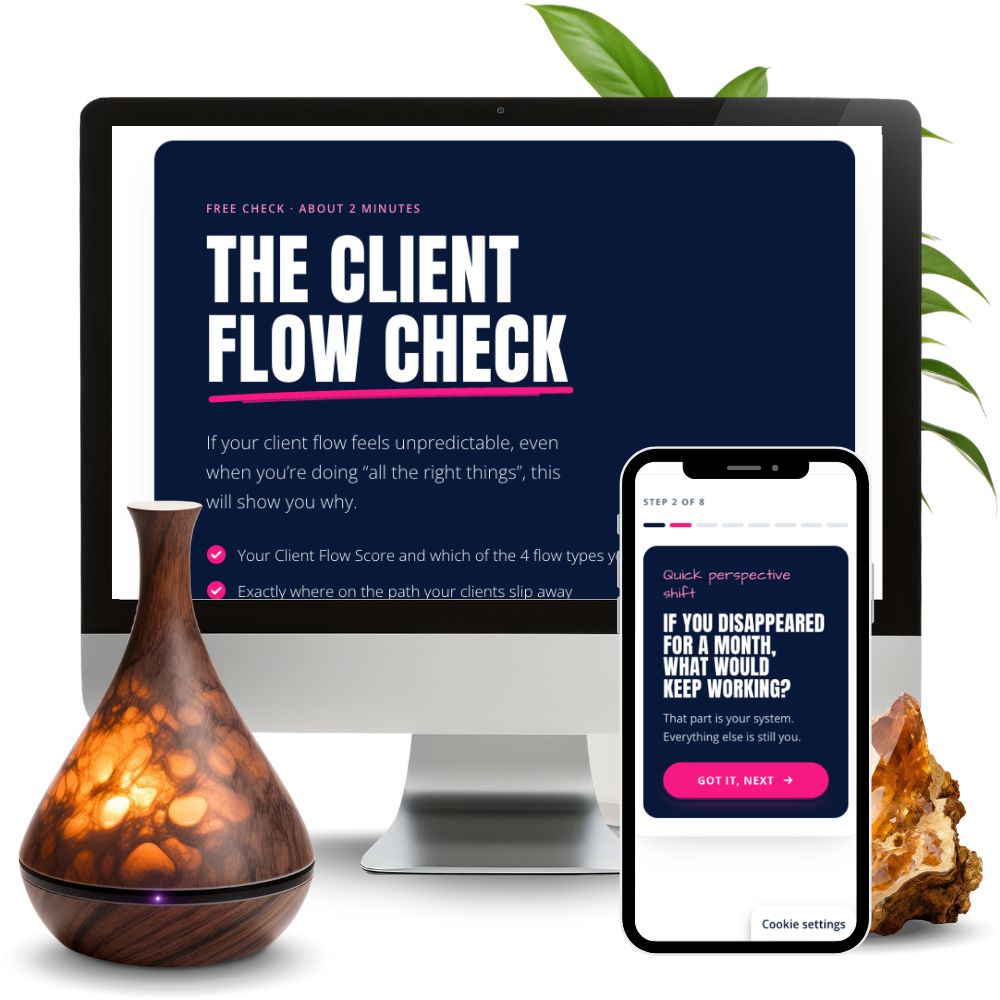
The Client Flow Check

The Client Flow Check helps you identify what’s getting in the way of consistent inquiries, so you can decide what to work on next.

TAKE THE CLIENT FLOW CHECK

PREFER TO READ?↓

Why Am I Not Getting Clients? It’s Probably Not Your Audience

If you’re not getting clients, the problem is probably not the size of your audience. More often, the right people do see you but don’t recognize that your offer is for them, can’t easily find how to buy, or don’t understand what they’ll get. Fix those three things and you can get more clients from the exact same audience you have right now, without more followers or ads.

Below I explain why a bigger audience rarely solves the problem, the three changes most solopreneurs never make, and a simple example of what they can do for your numbers.

Why a bigger audience usually isn’t the answer

One sentence I hear all the time is “I just need a bigger audience.” When clients don’t come, most of us try to reach more people: more followers, more posts, maybe more ads, maybe hoping something goes viral. It’s the most logical thing to do, and I’ve been there too. But it’s usually the wrong solution.

The belief behind it is that more people means more clients. If 1,000 people see my offer and nobody buys, surely 10,000 will bring a few clients.

A well-known example shows why that’s not always true. In 2019, Instagram influencer Arii, who had about 2.6 million followers, launched her own clothing line. She needed to sell at least 36 T-shirts for the company to produce them, and she couldn’t reach that number. I’m not sharing this to make fun of her. She was open about it, and it’s a lesson for all of us: a bigger audience usually doesn’t fix your problem, it just shows it to more people.

When it doesn’t work, it’s easy to start doubting yourself and thinking you’re just not good enough. That’s rarely the real reason. What matters is not how many people see you, but how many of your ideal clients see your offer and understand that you’re the right choice for them. It doesn’t matter how many followers you have. What matters is how many of them come to your website and become clients, whether they buy something or send you an inquiry.

Most of the time when clients don’t come, we’re not solving the real problem because we don’t know what it is. That’s why I made the Client Flow Check, a free quiz with a few quick questions that shows you where your client flow actually breaks. You don’t need to sign up, you just answer and get your result.

3 changes that bring more clients from the same audience

1. Make your message specific

If your bio says something like “I help women live their best life,” I have bad news. Nobody knows if that’s for them, because “best life” means something different to every single person. The right client sees you, doesn’t recognize that this is for her, and keeps scrolling.

Compare that with “I help busy moms reach their ideal weight.” The right person knows immediately that it’s for her. And someone who isn’t a mom, maybe a busy businesswoman with a lot on her plate, knows it isn’t. Being specific isn’t a limitation, it’s an advantage. The more specific you are, the easier it is for your dream clients to find you.

2. Make the path to buying easy

I once did a website review for a client and couldn’t find anywhere on the website where I could actually buy. When I asked her how people usually buy from her, she said they go to the contact page and send her a message. She was losing clients without even knowing it, because every extra step is a place where people leave.

Your website isn’t a business card. It’s your salesperson, or at least it should be. Every page needs a clear goal and should lead visitors to the next step.

The same goes for too many options. When there are five different ways to start, people often choose none and simply leave. Make the path from visitor to client as easy as you can.

3. Make your value clear

A website can sound beautiful and look beautiful, full of big words and nice design, and your potential clients still have no idea what they’ll get. I see this more and more often.

AI can be a great help when you write your pages, but it shouldn’t write them 100% for you. The same can happen when someone else writes or designs your website: the words are nice, but it’s not clear what people get, what they can expect and what results they’re working towards. When that doesn’t connect, potential clients get lost and leave.

A prettier or more modern design doesn’t raise your price. A clear message about the value you give does. If you want to go deeper into this, read my article on how long a sales page should be and what it needs.

Same audience, five times more clients

Here’s a simple example to show what these changes can do. Let’s say 100 people visit your page today and one of them buys. That’s a 1% conversion rate.

Now imagine you make your message clear, show one clear next step and explain your value, and your conversion rate goes up to 5%. The same 100 visitors now bring you 5 clients instead of 1. Same audience, same traffic, five times more clients. That’s why I always start with these three things before trying to grow an audience.

What helps you get clients even on days you don’t post

These three changes help the right people choose you. To get clients even on days you don’t post, you also need a simple system behind them. I show my whole system in the article on how I get clients without posting every day, and if you want to build it step by step, you can do that with Client Machine.

FAQ

Why am I not getting clients even though people see my content?

Usually because something between “seeing you” and “buying” isn’t working. The most common reasons are an unclear message, a complicated path to buy and value that isn’t explained clearly. the Client Flow Check can help you find which part is breaking.

Do I need more followers to get more clients?

Not necessarily. If your conversion improves, the same number of visitors brings more clients. In the example above, going from 1% to 5% conversion turns 100 visitors into 5 clients instead of 1.

How specific should my message be?

Specific enough that your ideal client recognizes herself immediately, and someone who isn’t a fit knows it isn’t for them. Name who you help and what result you help them reach, instead of using general phrases like “your best life”.

Can a beautiful website still lose clients?

Yes. A beautiful design with unclear words can leave visitors unsure what they’ll get, so they leave. Clear value, a clear goal for each page and an easy next step matter more than how modern the design looks.

Filed Under: Get More Clients | The Playbook

How Long Should a Sales Page Be? 3 Questions That Give You the Answer

October 30, 2026

IN THIS EPISODE …

How long should a sales page be? Instead of “it depends”, I answer with three simple questions about price, where your visitors come from and how aware they are, plus the parts every sales page needs whatever its length.

PREFER TO READ?↓

// LINKS MENTIONED ⇩

  • The Client Flow Check: a short quiz that shows where your client flow is breaking
  • Client Machine: my step-by-step program for building a freebie, email and offer system
  • How I Get Clients Without Posting Every Day (video)

FREE

The Client Flow Check

The Client Flow Check helps you identify what’s getting in the way of consistent inquiries, so you can decide what to work on next.

TAKE THE CLIENT FLOW CHECK

PREFER TO READ?↓

How Long Should a Sales Page Be? 3 Questions That Give You the Answer

A sales page should be long enough for your potential client to make an informed decision about whether to buy, and not one word longer. The right length depends on three things: how much your offer costs, where your visitors come from, and how aware they already are of their problem and your solution.

Below I go through each of these three questions, explain the five stages of awareness, and share the parts every sales page needs no matter how short it is. I’ve written and designed a lot of sales pages over more than ten years, and this is the question I hear most often.

Why length is rarely the real problem

Here’s what I see all the time. People are convinced their sales page is too long or too short, so they cut it or add more, and nothing really changes. By nothing, I mean sales.

A page that’s too short doesn’t give your potential client enough to decide. A page that’s too long can lose their attention. But you don’t fix either of those by counting words. You fix it by asking what your visitors need to know before they can say yes or no.

Question 1: How much does your offer cost?

A higher-priced offer usually needs a longer, deeper page, because people need more information and more trust before they invest in you and your offer. A lower-priced offer can be shorter, and some sections can be combined.

This isn’t an absolute rule. Price can influence the length, but the key parts of the page always stay.

Question 2: Who is landing on your page, and from where?

A visitor from your email list usually already knows you and your offer, unless they’ve only just joined. They need a shorter page, just enough to order. A visitor who just clicked a Facebook ad and has never heard of you usually needs much more before they can decide.

That means the same offer can need two different pages. What I usually recommend is one more complete page for cold visitors and one shorter version for a specific campaign, for example after a webinar or a video series.

And sometimes the sales page isn’t the problem at all. People never even get to it, or they arrive when they’re not ready yet. If you want to see where your client flow actually breaks, take the Client Flow Check. It’s a free quiz with a few quick questions, and you don’t need to sign up.

Question 3: How aware are your visitors?

This is probably the most important question. It comes from Eugene Schwartz, one of the most famous copywriters, who described five stages of awareness in his book Breakthrough Advertising. These stages tell you not only how long your page should be, but also what goes on it and in what order from top to bottom.

The 5 stages of awareness

  1. Unaware: they don’t even know they have a problem. You need to show that the problem exists, educate, give proof and explain the consequences. Think of someone selling a back pain solution to people who don’t feel any pain yet. We usually don’t write sales pages for this group, they first need content.
  2. Problem aware: they know their problem but not the solution. You need empathy and an explanation of the real cause of their problem. For example, a woman in her 40s who feels irritable all the time may not know it can be caused by a hormonal imbalance.
  3. Solution aware: they know a solution exists and they’re comparing offers. You need proof, results, numbers and a clear explanation of what makes your offer different. “I work from the heart” isn’t unique enough to make someone buy.
  4. Product aware: they know your offer. The page can be shorter, because they already understand the problem and the solution. For people on your email list, you can create a short page that starts with the product-aware section.
  5. Most aware: they’re ready to buy. This is the shortest page: the investment, a summary of what they get and a clear call to action.

The rule of thumb is simple: the less aware your visitors are, the longer your page usually needs to be.

What every sales page needs, whatever its length

No matter how short your page is, some things always stay:

  • A clear presentation of your offer, including what’s included.
  • Call-to-action buttons. The last thing visitors see on the page should always be the button to buy.

And rule number one: never send visitors away from your sales page to another page. Extra information goes into a click-to-open section or further down the page. A mistake I see often is a short “about me” section with a “read more about me” link that sends visitors to the About page. It’s a great link anywhere else, but on a sales page you don’t want to send people away when they’re already getting ready to buy.

Write the content first, then design the page

One more tip, and as a designer this one matters to me. Write all the content first, all the way to the end, and only then design the page. Never do both at the same time. When you design while you write, you start counting words to fit the design, and the page loses what your potential clients need to decide.

So, how long should your sales page be?

Ask yourself three questions:

  1. How much does your offer cost?
  2. Where do your visitors come from?
  3. How aware are they?

But a sales page is only the last part of the system. If people don’t arrive warm and ready, even a perfect page won’t sell. In my article on how I get clients without posting every day, I show the freebie, email and offer system that brings people to the page ready to decide. If you’d like to build that system step by step, have a look at Client Machine.

FAQ

Is a long or short sales page better?

Neither is better on its own. A longer page suits higher prices and cold visitors who don’t know you yet. A shorter page works for lower prices and for people who already know your offer, for example your email subscribers.

How long should a sales page be for a low-priced offer?

It can usually be shorter, and some sections can be combined. It still needs a clear presentation of the offer, what’s included and a call-to-action button at the end.

Should I have different sales pages for different audiences?

It often makes sense. I usually recommend one complete page for cold visitors and a shorter version for a specific campaign, such as after a webinar or video series, when visitors already know you.

What are the five stages of awareness?

Eugene Schwartz described five stages: unaware, problem aware, solution aware, product aware and most aware. The less aware your visitors are, the more your page needs to explain before they can decide.

Should I link to other pages from my sales page?

No. Keep visitors on the sales page. Put extra details in a click-to-open section or further down the page instead of linking to your About page or other content.

Filed Under: Get More Clients | The Playbook

Do You Need to Post Every Day on Social Media? What I Do Instead as a Solopreneur

October 30, 2026

IN THIS EPISODE …

Do you really need to post every day to get clients? In this episode I explain why most “post more” advice is made for people with a team, and the three shifts I use instead as a solopreneur, including my simple weekly content system.

PREFER TO READ?↓

// LINKS MENTIONED ⇩

  • The Client Flow Check: a short quiz that shows where your client flow is breaking
  • Client Machine: my step-by-step program for building a freebie, email and offer system
  • Gary Vaynerchuk on creating 100 pieces of content a day
  • Team GaryVee
  • Solo & Booked newsletter on Substack

FREE

The Client Flow Check

The Client Flow Check helps you identify what’s getting in the way of consistent inquiries, so you can decide what to work on next.

TAKE THE CLIENT FLOW CHECK

PREFER TO READ?↓

Do You Need to Post Every Day on Social Media? What I Do Instead as a Solopreneur

No, you don’t need to post every day on social media to get clients, especially if you run your business alone. Posting more makes you look busy and can easily burn you out, but neither of those shows up in your bank account. What helps more is making every piece of content lead somewhere, putting most of your energy into one channel where content lasts, and turning that one piece into everything else.

Below I explain where the “post more” advice comes from, what it quietly costs a solopreneur, and the simple weekly content system I use instead, without a social media team.

Why most “post more” advice isn’t made for solopreneurs

I love working solo. For me it’s not a phase or a step before growing a team, it’s a choice. But it comes with one challenge: most business advice out there is made for people who have a team. Posting every day is easy when someone else creates your content. When it’s just you, you need a different way.

To be fair, the people who say “post more” aren’t completely wrong. Probably the best-known voice of this advice is Gary Vaynerchuk. In a post on his website he quotes his keynote, where he says that if you’re not producing 100 pieces of content every single day, you’re missing out. For him, it probably does work.

On the same website you can also see the team behind his content: more than 30 people who publish well over a hundred pieces of content every week, creating the videos, clips, graphics and copy for his personal brand. He’s open about that. So the advice isn’t wrong, it’s simply made for someone with a team.

Does visibility still matter?

Yes. If nobody sees you, nobody can buy from you. I’m not saying you should leave social media or stop showing up on your channels. But when you work without a team, “post more” comes with some hidden costs that most people don’t see.

The hidden costs of posting more

Every piece of content you make is either building your business or feeding an algorithm, and most entrepreneurs are doing the second one without even knowing it. A post on social media lives maybe 48 hours, then it’s gone and you start again from zero.

There are a few other costs too:

  • When every post is an ad, your profile turns into a notice board. Nobody wants to follow it and nobody stops to read.
  • Posting more can lead to burnout, and you won’t see that in your bank account either.
  • The quality of your posts slowly drops, because nobody can create great content every single day alone.
  • You end up exhausted and still not sure where your clients come from.

So before you decide to post more, find out where your client flow actually breaks. Maybe the problem isn’t your content at all. I made a free quiz for this, the Client Flow Check. It’s about eight quick questions, takes less than five minutes and shows you where your flow is broken.

What I do instead of posting every day

1. Make every piece of content lead somewhere

Almost every piece of content should lead somewhere. I don’t mean “follow me”, I mean one clear next step, like your freebie. Sometimes you invite people directly, sometimes you just mention it.

This doesn’t mean every post is a sales post. Your social media shouldn’t feel like a notice board, but at least once a week show people where to go next, or even how to buy from you.

One of my best sales came from an email where I didn’t sell anything. I shared an experience with a wonderful entrepreneur I had worked with a few years ago. So many women recognized themselves in that story that they bought my offer, even though I never directly sold it in that email. Later I posted almost the same text on Instagram, and it worked really nicely there too.

2. Put your main energy into one channel where content lasts

Choose one main channel where content lives for a long time, like YouTube or the blog on your website. Then use it to create content for the platforms where posts have a shorter lifespan.

This way every piece of content is like a brick in your business. You’re building a house, not drawing in the sand that washes away the next day. Spending hours on a post that lives for 48 hours is a waste, unless that post converts really well. In that case, keep doing what you’re doing.

3. Turn one piece of content into everything else

This is exactly how I work, and it’s my answer to 100 pieces a day without a team. For my Slovenian business, I create one video a week. That video becomes a blog post, then my newsletter, then social media posts, some right away and some later as repurposed content. Sometimes a post invites people to watch the video, sometimes it shares one piece of it, and occasionally I also run ads.

I prepare all my Instagram posts for the next month in one day, and I usually share the same posts on Facebook and LinkedIn with small changes. I know this probably isn’t the best social media strategy on paper, but it works for me.

I’m now building the same system for Solo & Booked. Every Wednesday I record a new YouTube video. Recording, editing and getting the email newsletter ready to publish takes me about an hour. AI tools help me with some of the tasks, but they don’t create the content for me. Once a week I also write my Solo & Booked newsletter with behind-the-scenes lessons from my business.

Content is only one part of the system

These three shifts change how you create content, but content is only one part. If people who find you have nowhere to go next, even great content won’t bring steady clients. You can see the whole system in my article on how I get clients without posting every day, and if you want to build it step by step, that’s what Client Machine is for.

FAQ

How often should a solopreneur post on social media?

As often as you can keep up the quality without burning out. I create one main piece of content a week and turn it into posts for the other platforms, instead of trying to create something new every day. What matters more is that your posts regularly point people to a clear next step.

Is it bad to repost the same content on several platforms?

No. I share the same posts on Instagram, Facebook and LinkedIn with small changes, and I reuse my emails as posts. Adapt the format to each platform, but you don’t need to create something completely new for every channel.

Which channel is best for long-lasting content?

Channels where content can be found months later, like YouTube or a blog on your own website. Social media posts usually disappear from feeds within a couple of days, so they work best as a way to share and point back to your main content.

Does every post need a call to action?

Not every post, but almost every piece of content should lead somewhere. Aim to show people where to go next at least once a week, for example to your freebie, without turning your profile into a notice board.

Filed Under: Get More Clients | The Playbook, Running a Solo Business | Life Outside Work

How to Get Clients Without Posting Every Day (My Simple 3-Part System)

October 30, 2026

IN THIS EPISODE …

If you stopped posting for two weeks, would new clients still find you? In this episode I share the simple system I use to get clients without posting every day, built from a freebie, an email nurture sequence and an offer, and the order I build it in.

PREFER TO READ?↓

// LINKS MENTIONED ⇩

  • The Client Flow Check: a short quiz that shows where your client flow is breaking
  • Client Machine: my step-by-step program for building a freebie, email and offer system
  • Solo & Booked on Substack

FREE

The Client Flow Check

The Client Flow Check helps you identify what’s getting in the way of consistent inquiries, so you can decide what to work on next.

TAKE THE CLIENT FLOW CHECK

PREFER TO READ?↓

How to Get Clients Without Posting Every Day (My Simple 3-Part System)

You can get clients without posting every day when the people who find you have a clear place to go next. In my business, that place is a simple client system with three parts: a freebie, an email nurture sequence and an offer. Posting still helps, but it becomes a bonus instead of the engine that has to keep running for anything to happen.

Below I explain why posting more rarely solves the problem, how the three parts of the system work together, and the order I use to build them, starting from the offer rather than the freebie.

Why posting more doesn’t bring consistent clients

At the very beginning of my own business, I was always working on new leads and always looking for new people. What I wasn’t doing was keeping the people who had already found me, or warming them up. I see the same pattern with so many solopreneurs today: they post all the time, even when no clients come, and then chase every new trend in the hope that the next one will finally work.

The belief behind this is usually simple: if more people see me, more people will buy. In reality, it rarely happens that someone sees you for the first time and buys right away. More often they see you once, they like what you do, and then life happens. They get busy, they forget, they find something else to do or someone else to work with. That’s completely normal, but without a system to keep them close, they simply drift away.

So you post again and again, because when you stop, everything stops. It’s a hamster wheel. You can’t step off, not even when your health needs it or when you simply need a good rest, and you never really know where next month’s clients will come from.

I didn’t want to live like that. I wanted to be able to go for a walk in the middle of the day, take a day off when I needed one and go on holiday without guilt or worrying about where my clients would come from. So instead of chasing more visibility, I built a system.

What is a simple client system?

A simple client system is a path that takes someone from discovering you to working with you, without you having to push them along by hand every day. Mine has three parts:

  • A freebie brings people in. It’s a small, useful resource someone gets in exchange for their email address.
  • An email nurture sequence builds trust and keeps people warm while you’re busy with clients or simply living your life.
  • An offer is the natural next step once someone knows you and trusts you.

When these three parts are connected, a person who finds you once doesn’t disappear. They join your list, get to know you through your emails and come to your offer when they’re ready. That’s why posting becomes a bonus rather than the thing your whole business depends on. Honestly, running and growing a business this way is also a lot more fun.

First, find out where your client flow is breaking

When clients don’t come, we often try to fix the wrong thing, because we don’t actually know what the real problem is. Before building anything new, it helps to see where people get stuck on the way to working with you.

That’s why I made the Client Flow Check, a short diagnostic quiz. It’s about eight short questions, takes less than five minutes, and shows you your client flow gap and what to focus on next. If you take it before you read the steps below, they’ll be easier to apply to your own business.

How to build a client system that works without daily posting

1. Start with the offer, not the freebie

Most people start by deciding what freebie to make. I start with the offer. First, decide which offer you actually want to sell. Then ask yourself what the step before that offer looks like. What would be the perfect small taste of your work that naturally leads to it?

It has to be a win-win. If you only chase sign-ups, you can do more harm than good. People sign up because of what you promised, and if the freebie disappoints them, the chance that they’ll take the next step and buy from you is minimal, sometimes zero.

2. Find out what your audience really wants

To create a freebie people actually want, look at what’s bothering them and what they wish they had. Reddit forums and Amazon reviews in your niche are a good place to start, and AI tools can help you go through those forums and reviews much faster. You can also simply ask your own audience.

For my Client Flow Check, I chose the topic because I see the same thing all the time. When we talk about sales and clients, we’re usually not solving the real problem, and if we don’t solve the real problem, we can’t fix the main issue. So the first step is simply to see where the problem is.

3. Decide the format last

The biggest mistake I see is starting with the format. Will it be a PDF, a quiz, a video? The format should be your last decision. Strategy comes first, and only then do you ask what the best way is to solve this particular problem with a freebie.

For the Client Flow Check, the best format was a few simple questions with an instant answer and a clear next step. People don’t need to read anything long, they get their result right away.

4. Deliver the freebie through an email sequence

Next, add a simple way to deliver your freebie, and make sure the delivery is followed by an email sequence. The emails are where trust grows and where people stay warm while you’re doing other things. A freebie without emails after it is a nice gift, but it rarely leads anywhere.

5. Send people to your freebie in ways that keep working

Now you need a steady way to bring people to your freebie, ideally one that keeps working long after the day you post. For me, that’s YouTube, my Substack and ads that pay for themselves. Your mix may look different, but the question is the same: which channels keep sending people to your freebie while you’re not actively promoting it?

6. Measure and improve what’s already running

Once the system is live, look at what works and improve it. I regularly run A/B tests, for example on my email subject lines, so I know which version performs better. I also track which emails actually lead to sales and which don’t.

This is the part that changes the most for me. Instead of starting from zero every week with new content, you improve something that’s already running.

What changes when your client system is running

Today I can take time off without guilt, and that feels so freeing. What I love most is that you set the system up once, and in my experience it keeps bringing results months or even years later. You can still post when you have something to say, but your business no longer depends on it.

Want to build your client system step by step?

If you’d like to build this in your own business, I put my whole process into a program called Client Machine. Inside, you get step-by-step video trainings that take you through planning, creation, promotion and optimization. You also get templates you can fill in with your own words: a professional PDF template, a visual mockup template for your freebie, a simple freebie delivery system and an email nurture sequence template.

There are also three bonuses: a system for a steady flow of visitors to your freebie with five evergreen traffic methods, the AI Master Avatar for your ideal client profile, and the AI Detective for market research and freebie ideas. It’s a one-time payment with instant access.

If you’re not sure where to start, take the Client Flow Check first. It will show you which part of your client flow needs attention before you build anything new.

FAQ

Can you really get clients without posting on social media every day?

Yes, if people who discover you have a way to stay in touch with you. A freebie and an email nurture sequence keep potential clients warm between your posts, so one visit to your content can turn into a relationship instead of a one-time view. Posting can still support the system, but it doesn’t have to carry it.

What is a client attraction system?

A client attraction system is a connected path from first contact to paid work. In the version I use, a freebie attracts the right people, an email sequence builds trust over time, and an offer gives them a clear next step. Each part has one job, and together they work even on days you don’t show up online.

Should I create my freebie or my offer first?

Start with the offer. When you know what you want to sell, it’s much easier to design a freebie that is the natural step before it. A freebie created without the offer in mind may get sign-ups, but it rarely leads to sales.

What format should my freebie be?

Decide the format last. First get clear on the problem your freebie solves and how it leads to your offer, then choose the format that solves that problem most easily. For a diagnosis, a short quiz with an instant result works well. For a process, a checklist or template might be better.

How do I get people to my freebie if I don’t post often?

Use channels that keep working after you publish. For me, those are YouTube videos, my Substack and ads that pay for themselves. Then track which ones actually bring sign-ups and invest more in those.

Filed Under: Get More Clients | The Playbook, Running a Solo Business | Life Outside Work

Footer

Solo & Booked

Practical tools, courses, and support to help you build a business that brings in clients and leaves room for life.

Explore

Courses
Free: The Client Flow Check
My courses
Contact

Stay in touch

Get practical ideas for finding clients and making marketing fit into your day.

SUBSCRIBE ON SUBSTACK

WATCH ON YOUTUBE

Copyright © 2018–2026 mod.si

  • Terms
  • Privacy
  • Contact
  • Blog
  • Cookie Policy
Your privacy, your choice
We use essential cookies to keep your account, shopping cart and courses working. With your permission, we also use analytics, marketing cookies and external content. You can accept all, reject optional cookies or choose your preferences. You can change your choice at any time.
Essential Always active
Required for security, your cookie choices and the account, cart or course features you request. These cannot be switched off here.
Preferences
The technical storage or access is necessary for the legitimate purpose of storing preferences that are not requested by the subscriber or user.
Statistics
Helps us understand how visitors use this website. Enabled only with your permission. The technical storage or access that is used exclusively for anonymous statistical purposes. Without a subpoena, voluntary compliance on the part of your Internet Service Provider, or additional records from a third party, information stored or retrieved for this purpose alone cannot usually be used to identify you.
Marketing
Allows marketing measurement and external content such as YouTube videos. Enabled only with your permission.
  • Manage options
  • Manage services
  • Manage {vendor_count} vendors
  • Read more about these purposes
Manage preferences
  • {title}
  • {title}
  • {title}